
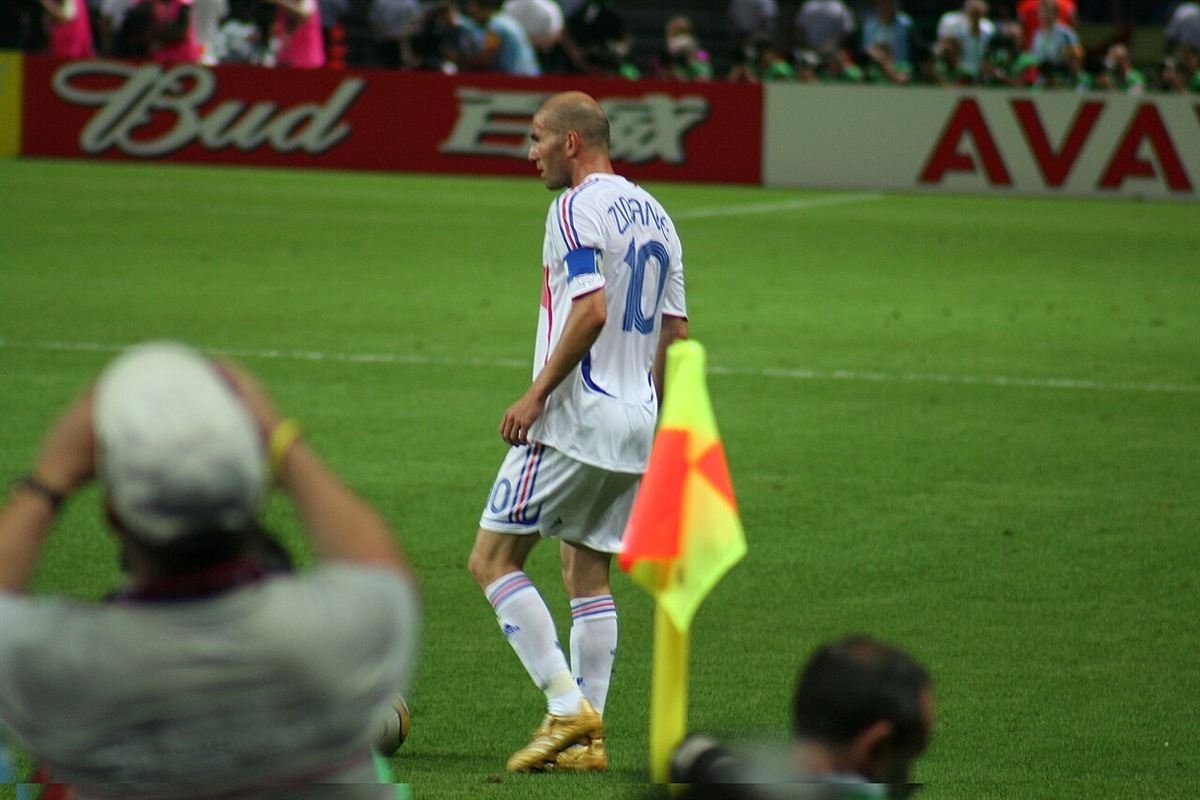
Zinedine Zidane: the maestro from Cannes to Berlin
From Cannes and Bordeaux to Juventus and Real Madrid, via the 1998 World Cup, a Champions League volley and the Berlin headbutt: the career of the playmaker the game still admires.
Some players are admired for what they won. Zinedine Zidane is admired for how he did it. He played as if the ball were a part of him, in no hurry, with a touch that made difficult things look like a decision rather than an effort. He won the World Cup at home, the European Championship two years later and the Champions League with a goal people still replay. And his playing career ended with one of the most famous red cards in the history of the World Cup.
It is a career across three countries: France, Italy and Spain, with the French national team running through all of it.
The numbers
| Team | Period | League games | League goals | All-competition goals |
|---|---|---|---|---|
| Cannes | 1989–1992 | 61 | 6 | 6 |
| Bordeaux | 1992–1996 | 139 | 28 | 39 |
| Juventus | 1996–2001 | 151 | 24 | 31 |
| Real Madrid | 2001–2006 | 155 | 37 | 49 |
| France (caps and goals) | 1994–2006 | 108 | 31 | 31 |
- 90/91: 1 goals
- 91/92: 5 goals
- 92/93: 11 goals
- 93/94: 8 goals
- 94/95: 8 goals
- 95/96: 12 goals
- 96/97: 7 goals
- 97/98: 11 goals
- 98/99: 2 goals
- 99/00: 5 goals
- 00/01: 6 goals
- 01/02: 12 goals
- 02/03: 12 goals
- 03/04: 10 goals
- 04/05: 6 goals
- 05/06: 9 goals
Zidane was never a scorer in the mould of a centre-forward, and the curve shows it. It climbs steadily through the Bordeaux years, holds at a respectable level in Turin, then collapses in 1998–99, the season after the World Cup, before recovering at Real Madrid, where two of his three best seasons came back to back. It tails off a little in the final years.
France: Cannes and Bordeaux
Zidane made his professional debut for Cannes on 18 May 1989, against Nantes, and scored his first goal against the same opponents nearly two years later, in a 2–1 win.
The step up came at Bordeaux, where he played alongside Bixente Lizarazu and Christophe Dugarry. They won the Intertoto Cup in 1995 and reached the 1995–96 UEFA Cup final, where they lost to Bayern Munich. Zidane was named Ligue 1 Player of the Year in 1996. His France debut had come in August 1994 against the Czech Republic, a 2–2 friendly in which he scored twice.
Italy: Juventus
Juventus signed him in 1996, and he won Serie A in each of his first two seasons, 1996–97 and 1997–98. The club also took the Intercontinental Cup and the UEFA Super Cup in 1996 and the Supercoppa Italiana the following year.
Italy was also where the Champions League first hurt. Juventus reached two finals in a row with Zidane in the side and lost both: 3–1 to Borussia Dortmund in 1997 and 1–0 to Real Madrid in 1998. The club that beat him in 1998 would be his next one.
1998: the summer France became champions
The World Cup at home that summer made Zidane a national figure, and the final made him a legend. France met Brazil at the Stade de France and won 3–0. Zidane scored twice, both with headers, both in the first half, from corners delivered by Emmanuel Petit and Youri Djorkaeff.
The year gave him the Ballon d'Or and the first of three FIFA World Player of the Year awards, and he was also awarded the Legion of Honour.
Euro 2000
Two years later France won the European Championship and Zidane was named Player of the Tournament. He scored a bending free kick against Spain in the quarter-final and a golden-goal penalty against Portugal in the semi-final. France were now champions of both the world and Europe, and Zidane was at the centre of both.
Spain: Real Madrid and the volley
In 2001 Real Madrid paid €77.5 million for him, a world-record fee at the time. His first season ended with the trophy that had eluded him at Juventus.
| Season | Club | Opponent | Result |
|---|---|---|---|
| 1996–97 | Juventus | Borussia Dortmund | Lost 3–1 |
| 1997–98 | Juventus | Real Madrid | Lost 1–0 |
| 2001–02 | Real Madrid | Bayer Leverkusen | Won 2–1 |
Hampden Park, 15 May 2002
The final in Glasgow against Bayer Leverkusen was not a quiet one. Raúl scored in the first minutes and Lúcio equalised soon after. Then, on the stroke of half-time, Roberto Carlos curled a cross from the left towards the edge of the area, and Zidane met it on the volley with his left foot, high into the far corner of the net.
It was the winning goal in a 2–1 victory, Real Madrid's ninth European Cup, and it is still regularly named among the greatest goals in the competition's history. The skill was not in the power. It was in the technique to hit a dropping ball so cleanly, and the calm to do it in a final.
Madrid added the UEFA Super Cup and the Intercontinental Cup later that year and La Liga in 2002–03. The Spanish Supercopa came in 2001 and 2003, and Zidane was named FIFA World Player of the Year again in 2003.
The trophies
Across four clubs and one national team, Zidane won the league in Italy and Spain, the Champions League, the World Cup and the European Championship, with a Ballon d'Or and three FIFA World Player awards on top.
| Team | Honour | Years |
|---|---|---|
| Bordeaux | Intertoto Cup | 1995 |
| Juventus | Serie A | 1996–97, 1997–98 |
| Juventus | Intercontinental Cup | 1996 |
| Juventus | UEFA Super Cup | 1996 |
| Juventus | Supercoppa Italiana | 1997 |
| Real Madrid | Champions League | 2001–02 |
| Real Madrid | La Liga | 2002–03 |
| Real Madrid | UEFA Super Cup | 2002 |
| Real Madrid | Intercontinental Cup | 2002 |
| Real Madrid | Supercopa de España | 2001, 2003 |
| France | World Cup | 1998 (winners) |
| France | European Championship | 2000 (winners) |
| France | World Cup | 2006 (runners-up) |
2006: the last match
Zidane announced in April 2006 that he would retire after the World Cup in Germany. He told Canal+ that he was stopping for good and stopping everything. His last home game for Real Madrid was on 7 May 2006, a 3–3 draw with Villarreal at the Bernabéu in which he scored twice. He left the pitch in tears, to repeated standing ovations.
Then came Germany, and one more run with France. In the final in Berlin, on 9 July, France faced Italy and Zidane gave them the lead in the seventh minute with a Panenka-style penalty. Italy equalised, and the match went to extra time. In extra time a Zidane header, from a cross by Willy Sagnol, was tipped over the bar by Gianluigi Buffon, a save that Buffon would later call the most important of his career.
The headbutt
Then, in the 110th minute, Zidane headbutted Marco Materazzi and was sent off. He did not take part in the shoot-out, which Italy won 5–3. It was the last act of his career: a red card in a World Cup final, with the trophy a few yards away.
The tournament still named him its best player, and he was awarded the Golden Ball. But the image that stayed was the other one.
"I want to apologize to them, but I can't regret what I did because it would mean that he was right to say what he said."
— Zidane on Canal+, July 2006, as reported by Al Jazeera
His position has barely moved in two decades. Asked about it again this month, ahead of France's match against Italy, he said he was not proud of what happened, but that it was part of his career, and that he had not spoken to Materazzi since.
Why they call him a master
The statistics of a Zidane career are good but not spectacular, and that is part of the point. The admiration is for something else, the way he played, and it came from the people who shared a pitch with him.
"To train with Zidane for three years was a dream. For me, he is the greatest player of all time."
— David Beckham, Zidane's team-mate at Real Madrid, quoted by The Football Faithful
"The most elegant footballer I have ever seen."
— Gary Lineker on Zidane, quoted by The Football Faithful
"I would give up five players to have Zidane in my squad."
— Cesare Maldini on Zidane, quoted by The Football Faithful
The common thread is elegance, from Lineker, from a team-mate like Beckham, from Maldini. It is the word people reach for when they try to describe how he played.
After he retired, the story had one more chapter. As Real Madrid's manager, he won the Champions League three years in a row, from 2016 to 2018: the player who had scored the volley in 2002 became the coach who kept winning the trophy.
The red card in Berlin will always be part of the story. It is not the whole of it.
Picks for you
Advertising. Affiliate links — we may earn a commission on your purchases, at no extra cost to you. It does not influence our editorial coverage.
Keep reading
 Legends
Samuel Eto'o: the striker who won back-to-back trebles
Two Champions Leagues with Barcelona, a third with Inter and the only back-to-back trebles with two clubs: the career of the Cameroonian striker who made big games his own.
 Legends
Zlatan Ibrahimović: the striker who never did things quietly
Twelve league titles in four countries, an overhead kick that won the Puskás Award and a retirement at 41: the career of the Swedish striker who played for Ajax, Juventus, Inter, Barcelona, Milan, PSG and Manchester United.
 Legends
Xavi Hernández: the Puppet Master of Barcelona and Spain
Four Champions Leagues, eight league titles, a World Cup and two European Championships: the career of the midfielder who set the tempo for the best Barcelona and Spain sides of their era.