
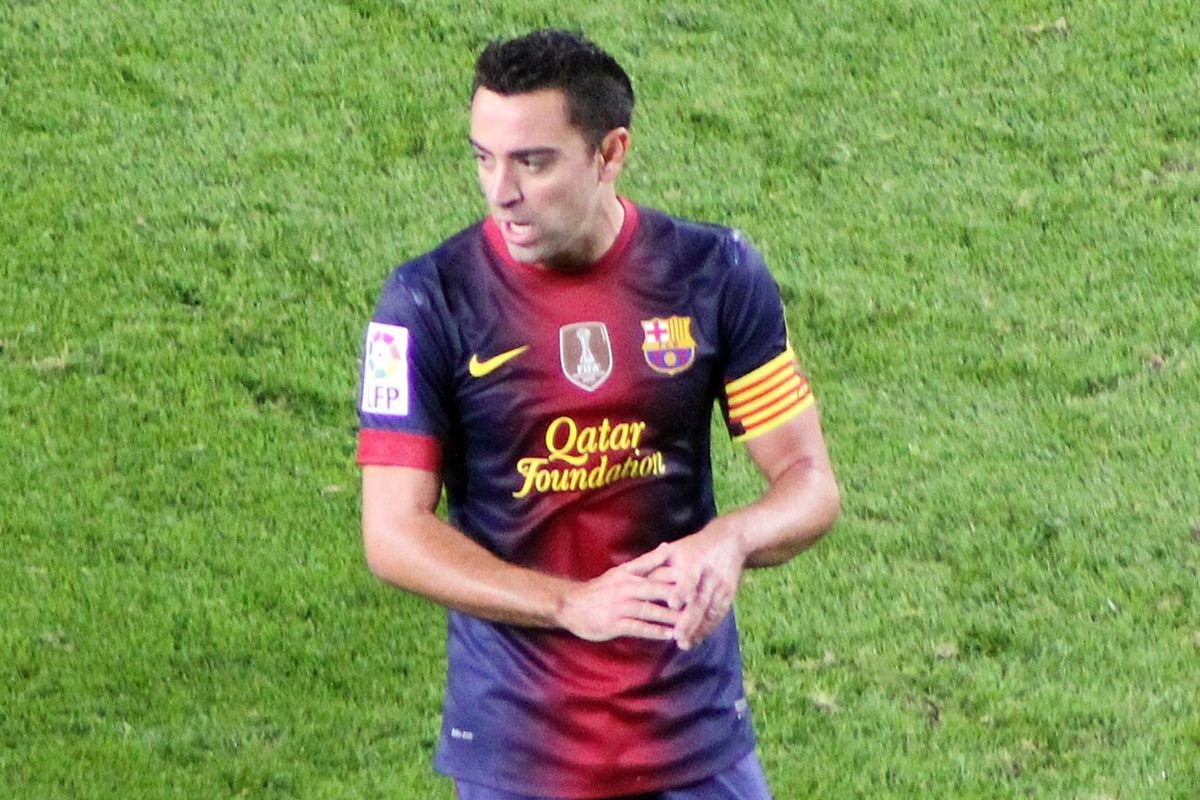
Xavi Hernández: the Puppet Master of Barcelona and Spain
Four Champions Leagues, eight league titles, a World Cup and two European Championships: the career of the midfielder who set the tempo for the best Barcelona and Spain sides of their era.
Most midfielders are judged by what they do with the ball. Xavi Hernández was judged by what everyone else did because of it. He set the tempo for Barcelona and for Spain through the years in which both teams were the best in the world, and he did it without relying on pace or physical power. What he had was the ability to find space, and the patience to wait for it.
He joined Barcelona as a boy, made his debut at 18 and left 17 years later with more trophies than almost anyone in the club's history.
The numbers
| Team | Period | League games | League goals | All-competition goals |
|---|---|---|---|---|
| Barcelona B | 1997–2000 | 55 | 3 | 3 |
| Barcelona | 1998–2015 | 505 | 58 | 85 |
| Al Sadd | 2015–2019 | 82 | 21 | 25 |
| Spain (caps and goals) | 2000–2014 | 133 | 13 | 13 |
- 97/98: 2 goals
- 98/99: 2 goals
- 99/00: 3 goals
- 00/01: 2 goals
- 01/02: 4 goals
- 02/03: 3 goals
- 03/04: 5 goals
- 04/05: 3 goals
- 05/06: 0 goals
- 06/07: 6 goals
- 07/08: 9 goals
- 08/09: 10 goals
- 09/10: 7 goals
- 10/11: 5 goals
- 11/12: 14 goals
- 12/13: 7 goals
- 13/14: 4 goals
- 14/15: 2 goals
- 15/16: 3 goals
- 16/17: 10 goals
- 17/18: 7 goals
- 18/19: 5 goals
Xavi was never a goalscorer, and the curve says so. It stays in the low single figures for the first nine years, drops to nothing in the season of the knee injury, then climbs unevenly through the Guardiola years to a peak in 2011–12, the most productive season of his career. At Al Sadd the curve rises again in his second year there, before the long tail of a veteran's last seasons.
Barcelona: from La Masia to the world
Xavi made his first-team debut on 18 August 1998 in the first leg of the Supercopa de España against Mallorca, and he won La Liga in that very season. He split his first seasons between the first team and Barcelona B, and it was from 2001–02 that he became a fixture in the middle of the pitch.
By 2004–05 he was vice-captain, and Barcelona won the league that year and the next. The 2005–06 season brought the lowest point of his career, a torn knee ligament that kept him out for four months. He came back in April and was on the substitutes' bench for the Champions League final against Arsenal, a title he watched rather than played in.
The Guardiola years
The decade that made him came after Pep Guardiola took over the first team. After Euro 2008, Guardiola convinced him to turn down Bayern Munich, and in return Xavi became the centre of one of the most celebrated sides in Barcelona's history. In 2009 he scored in the Copa del Rey final, a 4–1 win, and set up a goal in the Champions League final, 2–0 against Manchester United. He was the league's top provider that season.
| Season | Opponent | Venue | Result |
|---|---|---|---|
| 2005–06 | Arsenal | Paris | Won 2–1 (on the bench) |
| 2008–09 | Manchester United | Rome | Won 2–0 |
| 2010–11 | Manchester United | Wembley, London | Won 3–1 |
| 2014–15 | Juventus | Berlin | Won 3–1 |
Rome, 27 May 2009
Xavi was named UEFA's man of the match in Rome, a final in which he did not score. It says something about the kind of player he was: the best on the pitch without the stat to prove it. A few weeks earlier he had taken Real Madrid apart in a 6–2 win in the Clásico, with four assists in the match.
Barcelona won again in 2011 and again in 2015, in Berlin, where Xavi came on for Andrés Iniesta, wore the captain's armband and lifted the trophy.
Spain: the golden era
Xavi made his debut for Spain on 15 November 2000 in a friendly against the Netherlands and went on to be part of a Spain side that won three major tournaments in a row, between 2008 and 2012.
| Tournament | Result | What it left |
|---|---|---|
| European Championship 2008 | Winners | Player of the Tournament; final won 1–0 against Germany |
| World Cup 2010 | Winners | Tournament record for accurate passes, 599 at a 91% success rate; final won 1–0 after extra time against the Netherlands |
| European Championship 2012 | Winners | Two assists in the 4–0 final against Italy, the first player with assists in two European Championship finals |
| World Cup 2014 | Out in the group stage | The tournament after which he retired from Spain |
"We have chosen Xavi because he epitomizes the Spanish style of play."
— Andy Roxburgh, head of UEFA's technical committee, on naming Xavi Player of Euro 2008
The 2010 World Cup was the crowning achievement. Iniesta scored the goal in the 116th minute in Johannesburg, but Xavi completed 57 accurate passes in the opposition half in the final alone. Two years later in Kyiv, Spain thrashed Italy in the European final and he provided two of the goals.
His international career ended in 2014, when he announced his retirement after Spain went out of the World Cup in Brazil at the group stage, on 5 August.
The trophies
Xavi won everything on offer at Barcelona, several trophies more than once, plus the World Cup and two European Championships with Spain. The list is long enough that it is easiest to see it in one place.
| Team | Honour | Years |
|---|---|---|
| Barcelona | La Liga (8 titles) | 1998–99, 2004–05, 2005–06, 2008–09, 2009–10, 2010–11, 2012–13, 2014–15 |
| Barcelona | Copa del Rey | 2008–09, 2011–12, 2014–15 |
| Barcelona | Supercopa de España | 2005, 2006, 2009, 2010, 2011, 2013 |
| Barcelona | Champions League | 2005–06, 2008–09, 2010–11, 2014–15 |
| Barcelona | UEFA Super Cup | 2009, 2011 |
| Barcelona | FIFA Club World Cup | 2009, 2011 |
| Al Sadd | Qatar Stars League | 2018–19 |
| Al Sadd | Qatar Cup | 2017 |
| Spain | World Cup | 2010 |
| Spain | European Championship | 2008, 2012 |
| Spain U20 | FIFA World Youth Championship | 1999 |
| Individual | Third in the Ballon d'Or | 2009, 2010, 2011 |
| Individual | World Soccer Player of the Year | 2010 |
| Individual | UEFA Club Midfielder of the Year | 2008–09 |
| Individual | IFFHS World's Best Playmaker | 2008, 2009, 2010, 2011 |
Records
| Record | Detail |
|---|---|
| Barcelona appearances | 767 in all competitions, a club record until Lionel Messi passed him in 2021 |
| Barcelona trophies | 25 in 17 years, fifth on the club's all-time list behind Messi, Iniesta, Piqué and Busquets |
| Assists in 2008–09 | 28 across all competitions, including 20 in La Liga, the most in the league that season |
| Barcelona assists | Around 185 in the first team, including all competitions |
| 2010 World Cup passing | 599 accurate passes, a tournament record, at 91% |
| European Championship finals | First player with assists in two finals |
The Puppet Master
He is remembered as the Puppet Master, a nickname that fits a player whose influence on a match was always larger than his name on the scoresheet. In the middle of the pitch he lacked pace, but he was always one pass ahead. His signature was a 360-degree turn, the pelopina, which let him spin away from a pressing opponent and leave the next pass open.
"If football was a science, Xavi would have discovered the formula."
— Jorge Valdano on Xavi
"I get the ball, I give the ball, I get the ball, I give the ball."
— Pep Guardiola, describing Xavi's game
The most famous question of that Barcelona team was always about the middle: Xavi or Iniesta? Guardiola's assistant Lorenzo Buenaventura said the coach had a stock answer.
"People used to ask 'Xavi or Iniesta?' and Pep would say 'Xavi and Iniesta'."
— Lorenzo Buenaventura, in Iniesta's biography The Artist
The farewell
Barcelona gave him his goodbye on 23 May 2015, in a 2–2 draw with Deportivo at the Camp Nou, his last home league game for the club, and he gave a farewell speech.
"Not even in my wildest dreams could I have imagined what I experienced here at Barca. I was and am extremely happy."
— Xavi in his farewell speech at the Camp Nou, May 2015, as published by Telegrafi
He spent four more years at Al Sadd in Qatar, where he won the Qatar Stars League in 2018–19, and announced in 2019 that he would retire at the end of that season. He later went into management, winning the Qatari league with Al Sadd and La Liga with Barcelona in 2022–23.
A midfielder who never needed to score to be decisive, and who made the best players in the world better by passing them the ball.
Picks for you
Advertising. Affiliate links — we may earn a commission on your purchases, at no extra cost to you. It does not influence our editorial coverage.
Keep reading
 Legends
Samuel Eto'o: the striker who won back-to-back trebles
Two Champions Leagues with Barcelona, a third with Inter and the only back-to-back trebles with two clubs: the career of the Cameroonian striker who made big games his own.
 Legends
Zlatan Ibrahimović: the striker who never did things quietly
Twelve league titles in four countries, an overhead kick that won the Puskás Award and a retirement at 41: the career of the Swedish striker who played for Ajax, Juventus, Inter, Barcelona, Milan, PSG and Manchester United.
 Legends
Marco van Basten: the striker whose career ended too soon
Three Ballons d'Or, a Euro 1988 final volley still replayed today, a Milan side that won everything and an ankle that ended it all: the Dutch striker known as the Swan of Utrecht.