
Marco van Basten: the striker whose career ended too soon
Three Ballons d'Or, a Euro 1988 final volley still replayed today, a Milan side that won everything and an ankle that ended it all: the Dutch striker known as the Swan of Utrecht.
Some careers are remembered for how long they lasted. Marco van Basten's is remembered for how much he fitted into a short one. He won the Ballon d'Or three times, scored one of the most celebrated goals in the history of the European Championship, led the attack of a Milan side that won everything and played his last match at 28.
What he could do with a ball made it look easy, and the ankle that ended his career made it look cruel.
The numbers
| Team | Period | League games | League goals | All-competition goals |
|---|---|---|---|---|
| Ajax | 1981–1987 | 133 | 128 | 154 |
| AC Milan | 1987–1995 | 147 | 90 | 128 |
| Netherlands (caps and goals) | 1983–1992 | 58 | 24 | 24 |
- 81/82: 1 goals
- 82/83: 13 goals
- 83/84: 29 goals
- 84/85: 29 goals
- 85/86: 39 goals
- 86/87: 43 goals
- 87/88: 8 goals
- 88/89: 33 goals
- 89/90: 25 goals
- 90/91: 11 goals
- 91/92: 29 goals
- 92/93: 22 goals
The curve is two climbs and a cliff. At Ajax it rises almost every year to a peak in his last season there. At Milan the first year is a short one, interrupted by the ankle, and then it recovers to a high plateau with one dip in 1990–91. The last bar is the strangest: a season cut short by injury that still ends close to a goal a game.
Ajax: the successor to Cruyff
Ajax signed him as a 16-year-old, and he made his debut on 3 April 1982, coming on as a substitute for Johan Cruyff and scoring in a 5–0 win over NEC. Few players get a start like that, a debut goal in the shirt of the man they idolised, and fewer still live up to it.
Van Basten did. He was the Eredivisie's top scorer in four consecutive seasons, from 1983–84 to 1986–87, and took the European Golden Boot in 1985–86. In 1987 he scored the only goal of the Cup Winners' Cup final against Lokomotive Leipzig, a header in the 20th minute.
Milan: the side that won everything
In 1987 Silvio Berlusconi signed Van Basten and his compatriot Ruud Gullit for Milan, and an already ambitious club became a team that would define an era. Under Arrigo Sacchi, with Frank Rijkaard soon alongside them, Milan's Dutch trio became the spine of a side that won Serie A in Van Basten's first season and then took Europe.
The European Cup came in two years running. In the 1989 final in Barcelona Milan beat Steaua Bucharest 4–0, with Van Basten and Gullit scoring two each. A year later, in Vienna, they beat Benfica 1–0 when Van Basten slipped the ball to Rijkaard for the only goal.
Then came a change of coach. Van Basten fell out with Sacchi, Berlusconi sacked the manager, and Fabio Capello took over. The result was the most dominant Italian season of the era. Milan went through the whole of 1991–92 without losing a league match, an unbeaten run that eventually reached 58 games, and finished eight points clear of Juventus. Van Basten was Serie A's top scorer again.
The trophies
Van Basten's honours came in two places and a national team: the Eredivisie, the Dutch Cup and a European trophy with Ajax; the league and two European Cups with Milan; and the European Championship with the Netherlands.
| Team | Honour | Years |
|---|---|---|
| Ajax | Eredivisie | 1981–82, 1982–83, 1984–85 |
| Ajax | KNVB Cup | 1982–83, 1985–86, 1986–87 |
| Ajax | European Cup Winners' Cup | 1986–87 |
| AC Milan | Serie A | 1987–88, 1991–92, 1992–93 |
| AC Milan | European Cup | 1988–89, 1989–90 |
| AC Milan | Supercoppa Italiana | 1988, 1992 |
| Netherlands | European Championship | 1988 (winners) |
| Individual | Ballon d'Or | 1988, 1989, 1992 |
| Individual | FIFA World Player of the Year | 1992 |
| Individual | Serie A top scorer | 1989–90 (19 goals), 1991–92 (25 goals) |
| Individual | European Golden Boot | 1985–86 |
The Netherlands: the summer of 1988
Van Basten arrived at Euro 1988 in West Germany carrying his first ankle problems, and started the opening match on the bench. By the end of the tournament he was its top scorer, with five goals, and the Netherlands were European champions for the first time.
| Tournament | Result | What it left |
|---|---|---|
| European Championship 1988 | Winners | Top scorer; hat-trick against England, winner in the semi-final, the volley in the final |
| World Cup 1990 | Out in the second round | Lost 2–1 to West Germany, who went on to win the tournament |
| European Championship 1992 | Semi-finalists | Beaten by Denmark on penalties, with Peter Schmeichel saving Van Basten's kick |
Hamburg and the volley
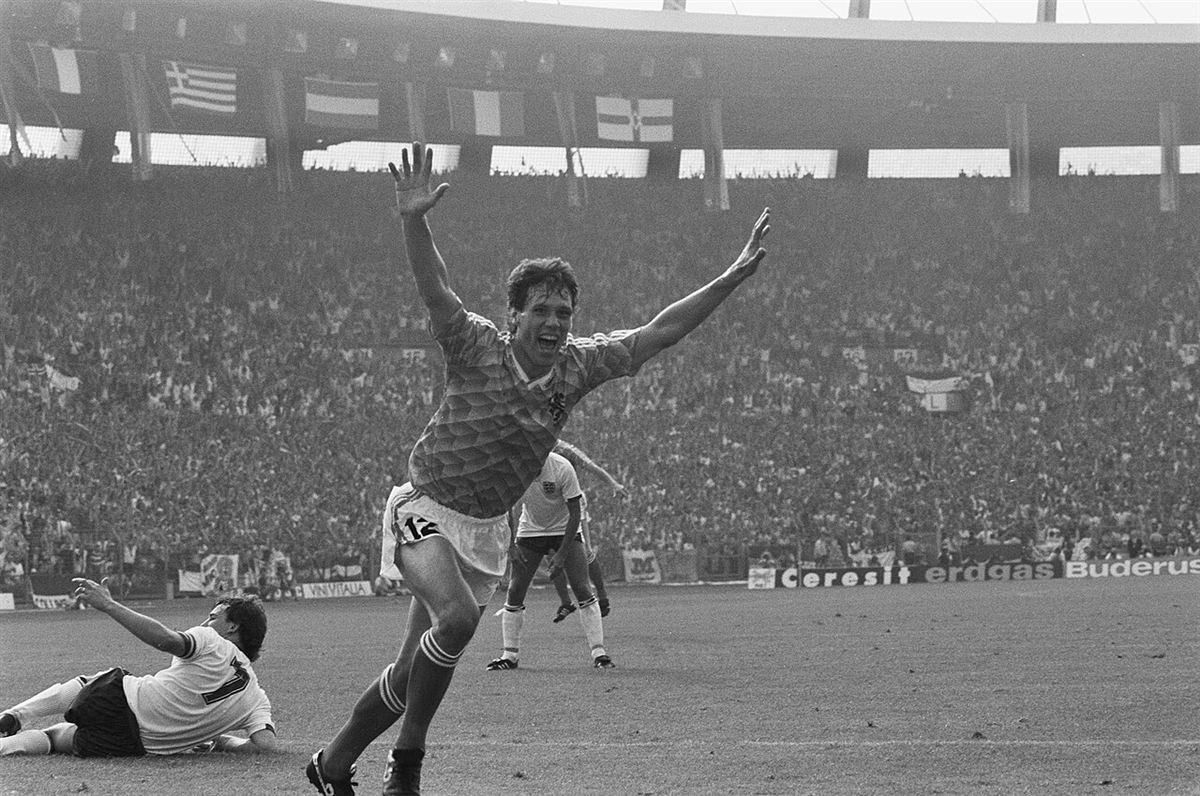
The group stage brought a hat-trick against England in a 3–1 win. The semi-final in Hamburg, against the hosts West Germany, was settled two minutes from time when Jan Wouters found Van Basten, who slotted the ball into the corner for a 2–1 win. And the final brought the goal everybody remembers: against the Soviet Union, with the Netherlands one goal up, a cross from Arnold Mühren dropped to Van Basten at an acute angle, and he volleyed it past the goalkeeper to make it 2–0.
"The ball came from Arnold Mühren and I was thinking, OK, I can stop it and do things with all these defensive players or I could do it the more easy way, take a risk and shoot."
— Van Basten on the Euro 1988 final volley, as told to UEFA
He has always been modest about it. You need a lot of luck with a shot like that, he told UEFA, and it is one of those things that sometimes just happens.
The ankle
The first sign of the ankle problem appeared around 1987, in his first season at Milan. It would come back repeatedly over the following years, each time with a layoff and, eventually, a series of operations. By 1992–93 he was making only a handful of appearances in a season.
The last of them was the 1993 Champions League final, on 26 May against Marseille. Milan lost 1–0. Van Basten came off in the 86th minute for Stefano Eranio after a hard tackle from behind by Basile Boli, an injury that led to the third ankle operation of his career. He never played for the club again.
He spent the next two years on the sidelines. On 17 August 1995, at 30, he announced his retirement. He returned to the San Siro one more time, before a home game, to thank the Milan fans, and Capello was in tears.
"The most frustrating thing for me is not the way I hurt my ankle, but the way I have been treated by some doctors because the person who damaged my ankle most was not a player, but a surgeon."
— Van Basten in a FIFA interview, December 1996
"Marco was the greatest forward I ever coached. His early retirement was a mortal misfortune for him, for football, and for Milan."
— Fabio Capello on Van Basten, as quoted by Football365
The swan
The nickname that stuck was the Swan of Utrecht, and it fitted. He was not only a finisher: in Serie A he also set up 24 goals for team-mates. His highlights include an overhead kick against Göteborg and a penalty taken with a distinctive hop in the run-up.
What his peers say about him is more telling than any statistic.
"Know that you were for me one of the greatest players in history."
— Arrigo Sacchi to Van Basten on his 60th birthday, as reported by Quotidiano Sportivo
"You were an incredible player, the strongest technically I have ever met."
— Paolo Maldini to Van Basten on his 60th birthday, as reported by Quotidiano Sportivo
He is still associated with a sense of what might have been, but he does not talk about it that way. Asked about his Milan years in 2024, he called them a wonderful cycle, and not only for the successes achieved.
A career that ended at 28 on the pitch still left three Ballons d'Or, two European Cups and one Euro 1988 volley. It also left the question every fan of the game has asked at least once: what if his ankle had held?
Picks for you
Advertising. Affiliate links — we may earn a commission on your purchases, at no extra cost to you. It does not influence our editorial coverage.
Keep reading
 Legends
Samuel Eto'o: the striker who won back-to-back trebles
Two Champions Leagues with Barcelona, a third with Inter and the only back-to-back trebles with two clubs: the career of the Cameroonian striker who made big games his own.
 Legends
Zlatan Ibrahimović: the striker who never did things quietly
Twelve league titles in four countries, an overhead kick that won the Puskás Award and a retirement at 41: the career of the Swedish striker who played for Ajax, Juventus, Inter, Barcelona, Milan, PSG and Manchester United.
 Legends
Xavi Hernández: the Puppet Master of Barcelona and Spain
Four Champions Leagues, eight league titles, a World Cup and two European Championships: the career of the midfielder who set the tempo for the best Barcelona and Spain sides of their era.