
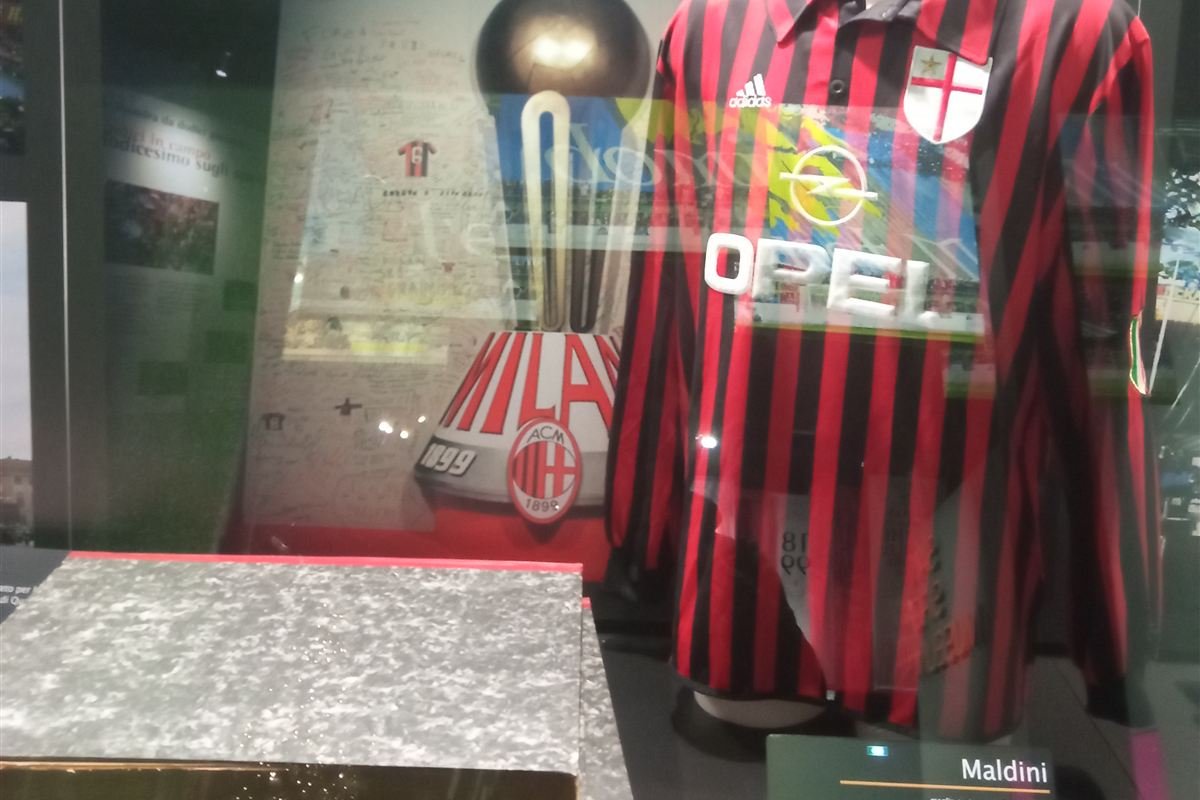
Paolo Maldini: the defender who never left Milan
Seven league titles, five European Cups, eight finals and a World Cup runner-up medal: the career of the one-club captain who played for Milan for a quarter of a century.
Defenders rarely become the faces of their teams. Paolo Maldini did. He played for one club for his entire career, wore the same shirt number for most of it, captained both Milan and Italy and was still starting games for the club that had given him his debut as a teenager when his own career was drawing to its end.
He won everything a defender can win, and a rare thing besides: the respect of the forwards he spent a career marking.
The numbers
| Team | Period | League games | League goals | All-competition games | All-competition goals |
|---|---|---|---|---|---|
| AC Milan | 1984–2009 | 647 | 29 | 902 | 33 |
| Italy (caps and goals) | 1988–2002 | 126 | 7 | 126 | 7 |
| Milan, by competition | Games | Goals |
|---|---|---|
| Serie A | 647 | 29 |
| Coppa Italia | 72 | 1 |
| European competitions | 161 | 3 |
| Other (Supercoppa, Intercontinental Cup and similar) | 22 | 0 |
- 84/85: 1 games
- 85/86: 40 games
- 86/87: 37 games
- 87/88: 29 games
- 88/89: 40 games
- 89/90: 47 games
- 90/91: 35 games
- 91/92: 38 games
- 92/93: 50 games
- 93/94: 46 games
- 94/95: 43 games
- 95/96: 41 games
- 96/97: 36 games
- 97/98: 37 games
- 98/99: 33 games
- 99/00: 38 games
- 00/01: 49 games
- 01/02: 19 games
- 02/03: 49 games
- 03/04: 42 games
- 04/05: 47 games
- 05/06: 23 games
- 06/07: 27 games
- 07/08: 23 games
- 08/09: 32 games
The curve is a portrait of durability. After a single appearance as a teenager it jumps to the level of a regular starter and stays there for almost two decades, with the biggest seasons coming in the years Milan played deep into Europe. The troughs near the end are the seasons when he played less, and the last bar shows him a regular again in his farewell season.
A boy from the academy
Maldini joined Milan's youth system in 1978, at ten, and was first tried as a right midfielder or winger. At 14 he was moved to right-back. His father Cesare had worn the number 3 shirt for Milan before him. On 20 January 1985, at 16, he made his Serie A debut, replacing the injured Sergio Battistini against Udinese under Nils Liedholm.
A year later he was in the starting eleven at right-back, with the number 3 on his back. He scored his first Serie A goal on 4 January 1987, in a 1–0 win over Como. Over the rest of his career he moved to left-back, where he played most of his games, and later to the centre of defence.
The Immortals and the Invincibles
The 1987–88 Scudetto under Arrigo Sacchi was his first trophy, and the first of seven league titles. Milan conceded only 14 goals that season, the best defence in Italy. The side became known as the Immortals, with the Dutch trio of Ruud Gullit, Frank Rijkaard and Marco van Basten up front and in midfield, and Maldini alongside Franco Baresi at the back. They won the European Cup in 1988–89 and again in 1989–90, along with back-to-back Intercontinental Cups, and in 1989 he was given the Bravo Award as the best young player in European competitions.
Under Fabio Capello the side that followed was called the Invincibles, and with reason: Milan went 58 league matches without defeat. In 1994 they beat Barcelona 4–0 in the Champions League final, with two goals from Daniele Massaro and one each from Dejan Savićević and Marcel Desailly. Maldini was named World Soccer's World Player of the Year, the first defender to win the award, and he finished third in the Ballon d'Or. In his acceptance speech, he said that defenders are more in the engine room than taking the glory.
| Season | Opponent | Result |
|---|---|---|
| 1988–89 | Steaua Bucharest | Won 4–0 |
| 1989–90 | Benfica | Won 1–0 |
| 1992–93 | Marseille | Lost 1–0 |
| 1993–94 | Barcelona | Won 4–0 |
| 1994–95 | Ajax | Lost 1–0 |
| 2002–03 | Juventus | Won 3–2 on penalties after 0–0 |
| 2004–05 | Liverpool | Lost on penalties |
| 2006–07 | Liverpool | Won 2–1 |
The captain
After Baresi and Mauro Tassotti retired at the end of 1996–97, Maldini was appointed Milan's captain. It was a difficult time for the club: they lost the Supercoppa to Fiorentina in 1996 and missed European competition for two seasons in a row. Maldini made his 400th Serie A appearance on 25 April 1999, in the season that brought the Scudetto under Alberto Zaccheroni, by a single point ahead of Lazio.
2003, 2005 and 2007
The new decade brought a new cycle. On 28 May 2003, at Old Trafford, Milan beat Juventus on penalties after a goalless draw, and Maldini was named Man of the Match. A year later, as captain, he led Milan to a Serie A title with a record number of points.
Istanbul
The 2005 final in Istanbul is the one he would not have chosen to remember. Maldini scored in the very first minute, the fastest goal ever in a European Cup final, and became the oldest player to score in a final. Milan then lost on penalties to Liverpool, a night his Wikipedia biography calls the worst moment of his career.
He had his answer two years later. On 23 May 2007, in Athens, Milan beat Liverpool 2–1, and at 38 Maldini became the oldest captain to lift the Champions League trophy. In December that year, after beating Boca Juniors, he became the first European captain to lift the FIFA Club World Cup.
Italy
Maldini made his senior debut for Italy on 31 March 1988, aged 19, in a 1–1 friendly with Yugoslavia in Split. His father had called him up to the Under-21 side two years earlier, and he had played 12 times for them, scoring five goals.
| Tournament | Result | What it left |
|---|---|---|
| World Cup 1990 | Third place | His first World Cup, in Italy |
| World Cup 1994 | Runners-up | A clean sheet in the final against Brazil, lost on penalties |
| European Championship 2000 | Runners-up | A final lost |
| World Cup 2002 | Round of 16 | His last tournament, ended by a controversial elimination |
After Baresi retired from the national team in 1994, Maldini became full-time captain. On 7 October 2000, with his 113th cap, he passed Dino Zoff to become Italy's most-capped player. His international career ended on 18 June 2002, the day Italy went out of the World Cup in the round of 16.
The farewell
He played his 1,000th match as a professional on 16 February 2008, against Parma, counting Milan, Italy and youth teams. Maldini announced his retirement on 18 April 2009, and on 17 May, away at Udinese, he played his 900th official game for Milan.
His last match at the San Siro, on 24 May 2009, was a 3–2 defeat to Roma. He received a standing ovation, although a group of Milan's ultras protested against him as he said goodbye. He played his final match a week later, on 31 May, a 2–0 win over Fiorentina, to another standing ovation. Milan retired the number 3 shirt, as they had Baresi's 6, with the proviso that it could go to one of his sons if one of them made the first team.
The trophies
Maldini won seven league titles, five European Cups and every other club trophy on offer, and finished runner-up in a World Cup and a European Championship with Italy. The full list is in one place.
| Team | Honour | Years |
|---|---|---|
| AC Milan | Serie A (7 titles) | 1987–88, 1991–92, 1992–93, 1993–94, 1995–96, 1998–99, 2003–04 |
| AC Milan | Coppa Italia | 2002–03 |
| AC Milan | Supercoppa Italiana | 1988, 1992, 1993, 1994, 2004 |
| AC Milan | European Cup / Champions League (5 titles) | 1988–89, 1989–90, 1993–94, 2002–03, 2006–07 |
| AC Milan | UEFA Super Cup | 1989, 1990, 1994, 2003, 2007 |
| AC Milan | Intercontinental Cup | 1989, 1990 |
| AC Milan | FIFA Club World Cup | 2007 |
| Italy | World Cup | Runners-up 1994, third place 1990 |
| Italy | European Championship | Runners-up 2000 |
| Individual | World Soccer World Player of the Year | 1994 |
| Individual | Ballon d'Or | Third place in 1994 and 2003 |
| Individual | Bravo Award | 1989 |
Records
| Record | Detail |
|---|---|
| One club | 902 appearances for Milan, 647 of them in Serie A |
| Serie A seasons | 25, level with Francesco Totti |
| European Cup / Champions League finals | Eight played, level with Paco Gento |
| Italy appearances | 126, Italy's most-capped player when he retired |
| World Player of the Year | First defender to win World Soccer's award, in 1994 |
| Champions League captain | Oldest to lift the trophy, at 38 |
| Red cards | Three in his whole career |
What the others said
Maldini played most of his career at left-back and later in the centre, a defender who relied on positioning and anticipation more than on the sliding tackle. He was also, by the standards of his position, a good attacker. The praise from the people who had to play against him is the best summary of what he was.
"Maldini was the best and toughest defender I ever faced. He had everything: he was a complete defender, who was strong, intelligent, and an excellent man-marker."
— Zlatan Ibrahimović on Maldini, as quoted on Wikipedia
"I always found it very difficult when I came up against Paolo Maldini. He was the best defender I faced over the course of my career."
— Ronaldo, the Brazilian striker, on Maldini, as quoted on Wikipedia
"Paolo Maldini. When you found him in front of you you knew you would not pass. He was big. He was strong with his head, with his right foot, with his left foot... You needed to put together 15 players to make one like him."
— Roberto Baggio, 2017, as quoted on Wikipedia
Ronaldinho noticed something else: that on the ball, he did not look like a defender at all, but like an elegant midfielder.
After the pitch
In August 2018, when Elliott Management bought Milan, Maldini returned to the club as sporting director, and in June 2019 he became technical director. Under him, the club signed players like Théo Hernandez, Rafael Leão and Mike Maignan, and in 2021–22 they won their first Serie A title since 2011. In November 2022 he received the Globe Soccer Awards' Sporting Director of the Year prize. Milan terminated his contract on 6 June 2023.
A one-club career that lasted a quarter of a century, followed by a second chapter at the same club.
Picks for you
Advertising. Affiliate links — we may earn a commission on your purchases, at no extra cost to you. It does not influence our editorial coverage.
Keep reading
 Legends
Johan Cruyff: the player who became a school of thought
Three Ballons d'Or, three European Cups with Ajax, the 1974 World Cup final and a second life as the coach who built Barcelona's Dream Team: the career of Johan Cruyff.
 Legends
Samuel Eto'o: the striker who won back-to-back trebles
Two Champions Leagues with Barcelona, a third with Inter and the only back-to-back trebles with two clubs: the career of the Cameroonian striker who made big games his own.
 Legends
Zlatan Ibrahimović: the striker who never did things quietly
Twelve league titles in four countries, an overhead kick that won the Puskás Award and a retirement at 41: the career of the Swedish striker who played for Ajax, Juventus, Inter, Barcelona, Milan, PSG and Manchester United.