
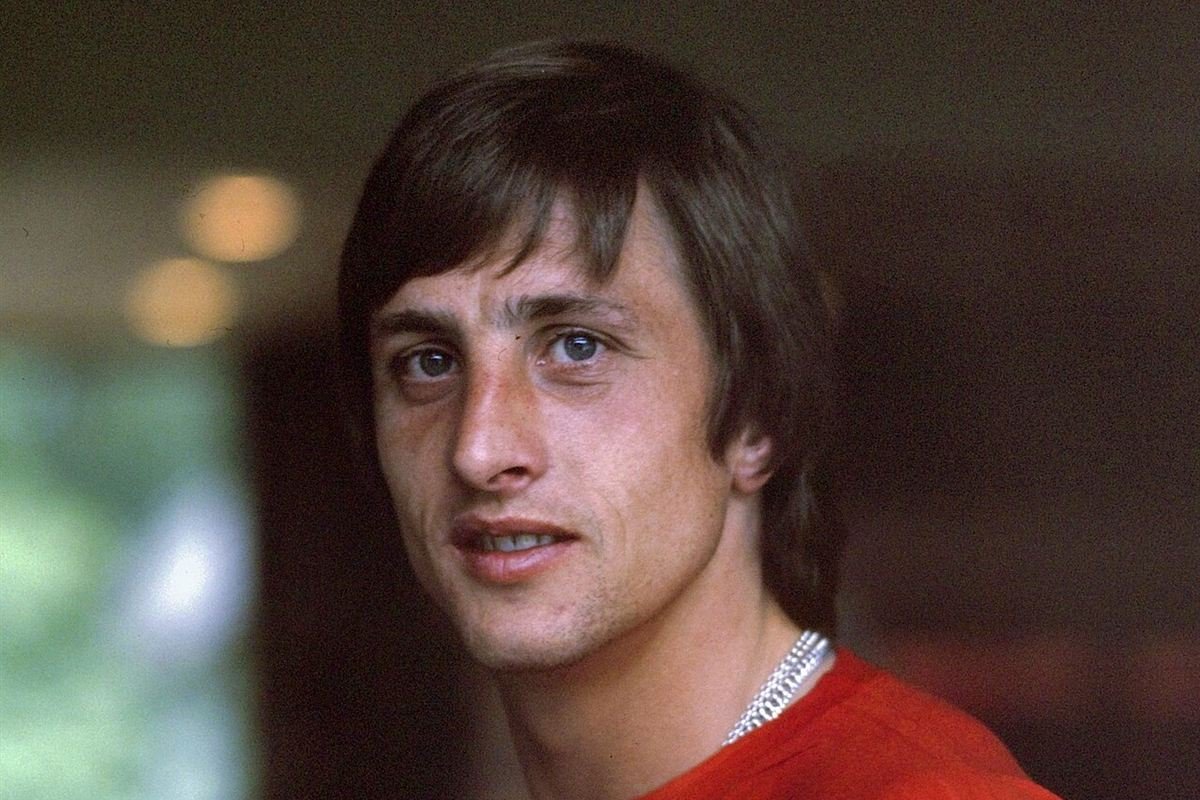
Johan Cruyff: the player who became a school of thought
Three Ballons d'Or, three European Cups with Ajax, the 1974 World Cup final and a second life as the coach who built Barcelona's Dream Team: the career of Johan Cruyff.
Johan Cruyff left his mark on the game twice. First as a player, at the centre of the Ajax and Netherlands sides that introduced Total Football to the world, and then as a coach, when he built the Barcelona side that became known as the Dream Team.
He was a forward who played everywhere, a player who coached from the pitch and a thinker who explained the game in sentences that people still repeat.
The numbers
| Team | Period | League games | League goals | All-competition goals |
|---|---|---|---|---|
| Ajax (first spell) | 1964–1973 | 245 | 193 | 257 |
| Barcelona | 1973–1978 | 143 | 48 | 85 |
| Los Angeles Aztecs | 1979 | 22 | 14 | 15 |
| Washington Diplomats | 1980–1981 | 29 | 12 | 12 |
| Levante | 1980–81 | 10 | 2 | 2 |
| Ajax (second spell) | 1981–1983 | 36 | 14 | 16 |
| Feyenoord | 1983–84 | 33 | 11 | 13 |
| Netherlands (caps and goals) | 1966–1977 | 48 | 33 | 33 |
- 64/65: 4 goals
- 65/66: 25 goals
- 66/67: 41 goals
- 67/68: 34 goals
- 68/69: 34 goals
- 69/70: 33 goals
- 70/71: 27 goals
- 71/72: 33 goals
- 72/73: 23 goals
- 73/74: 27 goals
- 74/75: 14 goals
- 75/76: 11 goals
- 76/77: 25 goals
- 77/78: 11 goals
- 1979: 15 goals
- 1980: 10 goals
- 1981: 4 goals
- 81/82: 7 goals
- 82/83: 9 goals
- 83/84: 13 goals
The curve rises at Ajax to a peak in his third season, then holds a high plateau through the years of the European Cups. At Barcelona the totals drop, apart from a spike in his fourth year there. After that the numbers are smaller, through the American spell and the last seasons in the Netherlands, until a final season that ended with the league title at Feyenoord.
Ajax: the birth of Total Football
Cruyff made his first-team debut on 15 November 1964, aged 17, in a 3–1 defeat to GVAV Groningen. Two months later Rinus Michels became the club's coach, introduced three training sessions a day and a pressing game he called hunting, and the style that became known as Total Football took shape around the young forward. Cruyff practised the false nine position, dropping deep to create space, and in effect acted as a player-coach, appearing almost everywhere on the field.
Ajax won the Eredivisie six times in his first spell, and Europe followed. They won the European Cup in 1971, against Panathinaikos, and again in 1972, when they beat Inter Milan 2–0 on 31 May with both goals from Cruyff. A third in a row came in 1973 against Juventus, by 1–0, through Johnny Rep. Ajax added the European Super Cup and the Intercontinental Cup in 1972, and Cruyff won the first two of his three Ballons d'Or, in 1971 and 1973.
Barcelona: a title after fourteen years
In 1973 Barcelona bought him for six million guilders, around two million dollars, making him the most expensive player in the world. He made his competitive debut on 28 October at the Camp Nou, in front of 90,000, against Granada, and scored twice in a 4–0 win.
Barcelona won La Liga in 1973–74, their first title in 14 years, clinching it in early April with a 4–2 win over Sporting Gijón. The match people remember from that season was in mid-February, when Barcelona beat Real Madrid 5–0 at the Santiago Bernabéu, with Cruyff scoring the second goal.
Off the pitch, he and his wife gave their son a name that the Franco government had banned in Catalonia without realising it: Jordi, the patron saint of the region. The choice was read as a political statement and made him even more popular. The 1974 Ballon d'Or was his third, and in 1977–78 he won the Copa del Rey, the last trophy of his Barcelona years.
The Netherlands: 1974 and the final that got away
| Tournament | Result | What it left |
|---|---|---|
| World Cup 1974 | Runners-up | Golden Ball as the tournament's best player; the Cruyff turn against Sweden |
| European Championship 1976 | Third place | The last major tournament he played |
The turn and the final
In the second group match, against Sweden, Cruyff faced the defender Jan Olsson, dragged the ball behind his standing leg with his heel and left him on the floor. It is known today simply as the Cruyff turn.
The final, in Munich, began as well as any team could dream. Within seconds Cruyff had the ball, and was brought down by Uli Hoeness. The referee, Jack Taylor, awarded a penalty, and Johan Neeskens scored it before the Germans had touched the ball. But West Germany came back to win 2–1, with Berti Vogts marking Cruyff out of the game for long periods.
"Johan was the better player, but I am a world champion."
— Franz Beckenbauer, on the 1974 final
He retired from international football in October 1977, after helping the Netherlands qualify for the 1978 World Cup, and did not go to Argentina. In 2008 he explained why: an attempt to kidnap him and his family in Barcelona the year before. To play a World Cup, he said, you have to be 200% okay, because there are other values in life.
The last years: America, Ajax and Feyenoord
Cruyff briefly retired in 1978, but financial problems after the collapse of an investment company forced him back to football. He signed with the Los Angeles Aztecs in May 1979 and was named the NASL's Player of the Year. After a spell with the Washington Diplomats and a short one at Levante, he returned to Ajax and won two more Eredivisie titles and a Dutch Cup.
Then Ajax declined to extend his contract, and he went to their rivals. At Feyenoord in 1983–84 he promised the championship after an early 8–2 loss to Ajax, and delivered it: the Eredivisie and the Dutch Cup, and a 4–1 win over Ajax in February in which he scored. He played his last domestic match on 13 May 1984, against Zwolle, and retired at 37, saying he could no longer meet the physical demands of the game.
The coach: the Dream Team
As a manager he won two Dutch Cups and the Cup Winners' Cup with Ajax, and then returned to Barcelona for the 1988–89 season. His first trophy was the Cup Winners' Cup in 1989, a 2–0 win over Sampdoria. What followed was the side that became known as the Dream Team.
Barcelona won La Liga four years in a row, from 1990–91 to 1993–94. And in 1992 they won the trophy the club had never won, the European Cup, beating Sampdoria in extra time, with Ronald Koeman scoring from a free kick in the 111th minute.
It ended badly. On 18 May 1996, after a conflict with the club president over control of transfers and a poor season, he was dismissed in the locker room by the vice-president, Joan Gaspart, who told him he no longer belonged there.
The trophies
Cruyff won titles as a player with Ajax, Barcelona and Feyenoord, and as a manager with Ajax and Barcelona. The two lists together are easiest to read in one table.
| Team | Honour | Years |
|---|---|---|
| Ajax (player) | Eredivisie | 1965–66, 1966–67, 1967–68, 1969–70, 1971–72, 1972–73, 1981–82, 1982–83 |
| Ajax (player) | KNVB Cup | 1966–67, 1969–70, 1970–71, 1971–72, 1982–83 |
| Ajax (player) | European Cup | 1970–71, 1971–72, 1972–73 |
| Ajax (player) | European Super Cup and Intercontinental Cup | 1972 |
| Barcelona (player) | La Liga | 1973–74 |
| Barcelona (player) | Copa del Rey | 1977–78 |
| Feyenoord (player) | Eredivisie and KNVB Cup | 1983–84 |
| Ajax (manager) | KNVB Cup | 1985–86, 1986–87 |
| Ajax (manager) | European Cup Winners' Cup | 1986–87 |
| Barcelona (manager) | La Liga | 1990–91, 1991–92, 1992–93, 1993–94 |
| Barcelona (manager) | European Cup | 1991–92 |
| Barcelona (manager) | European Cup Winners' Cup | 1988–89 |
| Barcelona (manager) | Copa del Rey | 1989–90 |
| Barcelona (manager) | Supercopa de España | 1991, 1992, 1994 |
| Barcelona (manager) | European Super Cup | 1992 |
| Individual | Ballon d'Or | 1971, 1973, 1974 |
| Individual | World Cup Golden Ball | 1974 |
| Individual | Eredivisie top scorer | 1966–67, 1971–72 |
| Individual | European Cup top scorer | 1971–72 |
| Individual | NASL Player of the Year | 1979 |
Records and rankings
| Record | Detail |
|---|---|
| Ballon d'Or | Three times (1971, 1973, 1974), third in 1975 |
| World transfer record | Six million guilders to Barcelona in 1973, the most expensive player in the world at the time |
| IFFHS European Player of the Century | First place |
| IFFHS World Player of the Century | Second place |
| FIFA 100 | Named in 2004 |
| World Cup All-Time Team | Named in 1994 |
How he thought about the game
His sayings travelled as far as his football. Some of them became proverbs in the Netherlands and in Spain, and books of his quotations were bestsellers.
"Playing football is very simple but playing simple football is the hardest thing there is."
— Johan Cruyff
"Winning is an important thing, but to have your own style, to have people copy you, to admire you, that is the greatest gift."
— Johan Cruyff
"In my teams, the goalie is the first attacker, and the striker the first defender."
— Johan Cruyff
He also had a sharp line for anyone who thought football was about effort alone: every coach talks about running, he said, but football is a game you play with your brain.
The farewell
He was diagnosed with lung cancer in October 2015 and died on 24 March 2016, aged 68. Barcelona's stadium at Sant Joan Despí carries his name today.
"He has enriched and personified our football. He was an icon of the Netherlands."
— King Willem-Alexander of the Netherlands, on Cruyff's death
Picks for you
Advertising. Affiliate links — we may earn a commission on your purchases, at no extra cost to you. It does not influence our editorial coverage.
Keep reading
 Legends
Paolo Maldini: the defender who never left Milan
Seven league titles, five European Cups, eight finals and a World Cup runner-up medal: the career of the one-club captain who played for Milan for a quarter of a century.
 Legends
Samuel Eto'o: the striker who won back-to-back trebles
Two Champions Leagues with Barcelona, a third with Inter and the only back-to-back trebles with two clubs: the career of the Cameroonian striker who made big games his own.
 Legends
Zlatan Ibrahimović: the striker who never did things quietly
Twelve league titles in four countries, an overhead kick that won the Puskás Award and a retirement at 41: the career of the Swedish striker who played for Ajax, Juventus, Inter, Barcelona, Milan, PSG and Manchester United.