
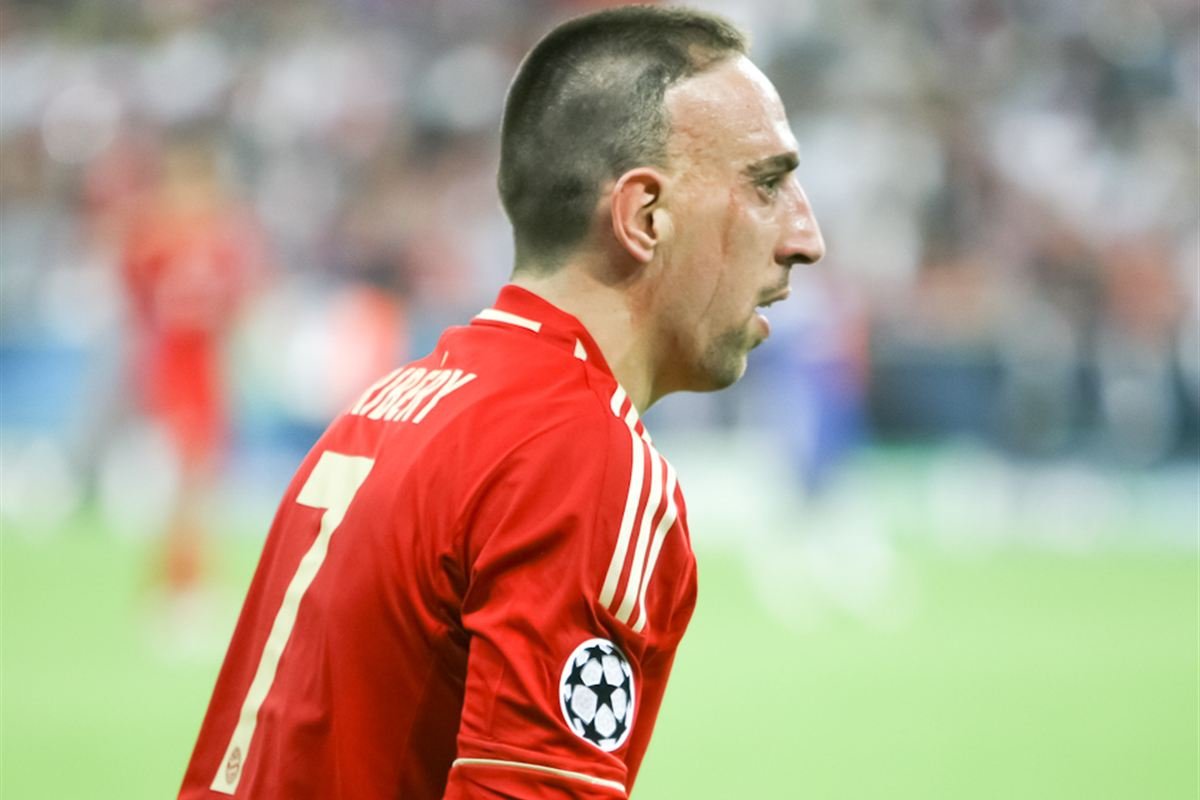
Franck Ribéry: from the lower leagues to Bayern's 2013 treble
He was released by Lille, played in the French third tier and ended up as a nine-time Bundesliga champion and Champions League winner: the career of Franck Ribéry.
Franck Ribéry reached the top by the long way. At 20 he was playing in the Championnat National, the third tier of French football. At 23 he was in the World Cup final. By 30 he was one of the best players in Europe, and he spent twelve years in Munich as the left winger of a Bayern that won everything.
He created more than he scored, and he was an emotional player, which brought him some of his best moments and some of his worst.
The numbers
| Team | Period | League games | League goals | All-competition goals |
|---|---|---|---|---|
| Boulogne | 2000–2002 | 28 | 6 | 6 |
| Alès | 2002–2003 | 19 | 1 | 1 |
| Brest | 2003–2004 | 35 | 3 | 4 |
| Metz | 2004–2005 | 20 | 2 | 2 |
| Galatasaray | 2005 | 14 | 0 | 1 |
| Marseille | 2005–2007 | 60 | 11 | 18 |
| Bayern Munich | 2007–2019 | 273 | 86 | 124 |
| Fiorentina | 2019–2021 | 50 | 5 | 5 |
| Salernitana | 2021–2023 | 24 | 0 | 0 |
| France (caps and goals) | 2006–2014 | — | — | 81 caps, 16 goals |
- 00/01: 1 goals
- 01/02: 5 goals
- 02/03: 1 goals
- 03/04: 4 goals
- 04/05: 3 goals
- 05/06: 12 goals
- 06/07: 6 goals
- 07/08: 19 goals
- 08/09: 14 goals
- 09/10: 7 goals
- 10/11: 11 goals
- 11/12: 17 goals
- 12/13: 11 goals
- 13/14: 16 goals
- 14/15: 9 goals
- 15/16: 2 goals
- 16/17: 5 goals
- 17/18: 6 goals
- 18/19: 7 goals
- 19/20: 3 goals
- 20/21: 2 goals
For a winger, goals are only part of the story, and his best years were the ones in which he created more than he scored. The curve peaks in his first Bayern season, 2007–08, and again in 2011–12 and 2013–14, then falls away from 2014–15 on.
The long way up
He started at six at an amateur club in Boulogne-sur-Mer and joined Lille in 1996, where, by his own account, officials wanted to drop him for being too small. Lille released him, and he returned to his hometown club, US Boulogne. After a year in the reserves he made four senior appearances, and the season ended with promotion to the Championnat National. In his second season, Boulogne were relegated.
He left for Alès, where he spent one season and left in March 2003 over unpaid wages, and then joined Brest, who finished second and won promotion to Ligue 2. Metz manager Jean Fernandez signed him on a free transfer, and in half a season in Ligue 1 he won the UNFP Player of the Month award in August 2004 and was compared with Robert Pires. He left for Galatasaray on 1 February 2005 on a three-and-a-half-year contract.
Marseille and a legal fight
Galatasaray won the Turkish Cup that season, but Ribéry said he had not been paid and asked FIFA to void his contract. FIFA ruled in his favour in July 2005. Galatasaray appealed to the Court of Arbitration for Sport, which on 25 April 2007 dismissed the appeal, finding he had ended his contract on just grounds.
He had already moved. On 15 June 2005 he announced his return to France with Marseille and a reunion with Fernandez. He made his debut on 30 July 2005 in a 2–0 defeat to Bordeaux, scored his first goal on 17 September in a 2–1 win over Troyes, and was named Ligue 1 Young Player of the Year in 2006.
The World Cup of 2006
He made his France debut on 27 May 2006, as a 74th-minute substitute in a 1–0 win over Mexico. He played all seven matches of the World Cup that summer, started six and scored France's opener in the 3–1 round-of-16 win over Spain. France lost the final to Italy on penalties.
Bayern: twelve years in Munich
On 7 June 2007 Bayern announced his signing from Marseille for €25 million, a club record then, on a four-year deal and with the number 7 shirt. He scored twice in his first competitive game, a 4–1 win over Werder Bremen in the Ligapokal, and in his first season Bayern won the league and cup double. He made the opener for Luca Toni in the DFB-Pokal final and was named Footballer of the Year in Germany.
| Team | Honour | Years |
|---|---|---|
| Galatasaray | Turkish Cup | 2004–05 |
| Marseille | UEFA Intertoto Cup | 2005 |
| Bayern Munich | Bundesliga (9 titles) | 2007–08, 2009–10, 2012–13, 2013–14, 2014–15, 2015–16, 2016–17, 2017–18, 2018–19 |
| Bayern Munich | DFB-Pokal (6 titles) | 2007–08, 2009–10, 2012–13, 2013–14, 2015–16, 2018–19 |
| Bayern Munich | DFL-Supercup | 2012, 2016, 2017, 2018 |
| Bayern Munich | UEFA Champions League | 2012–13 |
| Bayern Munich | UEFA Super Cup and FIFA Club World Cup | 2013 |
| France | World Cup | Runners-up 2006 |
| Individual | UEFA Best Player in Europe | 2012–13 |
| Individual | Bundesliga Player of the Year | 2012–13 |
| Individual | French Player of the Year | 2007, 2008, 2013 |
| Individual | Footballer of the Year in Germany | 2008 |
| Individual | Ballon d'Or | Third place, 2013 |
2012: two finals, no trophy
The first sign of what was coming was a year of lost finals. In the 2011–12 Champions League he scored Bayern's opener in the 2–1 first-leg win over Real Madrid on 17 April 2012. The final, on 19 May 2012 in Bayern's own stadium, went to Chelsea on penalties, and Ribéry was substituted in extra time after an injury from a tackle by Didier Drogba. A week earlier Bayern had lost the DFB-Pokal final 5–2 to Borussia Dortmund. Ribéry scored.
The treble
The following season everything went right. Bayern beat Dortmund in the DFL-Supercup on 12 August 2012 and won the Bundesliga, the DFB-Pokal and the Champions League. Ribéry finished with 15 Bundesliga assists, the most in the league, including a hat-trick of assists in a 5–0 win over Fortuna Düsseldorf on 20 October 2012.
It was not a flawless year. He was shown a straight red card in the DFB-Pokal round of 16 for slapping Augsburg's Koo Ja-cheol and missed the quarter-final against Dortmund and the semi-final against Wolfsburg. But Bayern won the final against VfB Stuttgart, and in the all-German Champions League final against Dortmund he made the assist for Arjen Robben's winning goal, 2–1.
The peak of 2013
The honours came in a stream. On 29 August 2013 he was named UEFA Best Player in Europe. The next day Bayern won the UEFA Super Cup against Chelsea on penalties after Ribéry scored in the 47th minute. On 21 December 2013 they beat Raja Casablanca 2–0 in the final of the FIFA Club World Cup, their first, and he won the Golden Ball.
He scored in the 3–1 win over Hertha Berlin on 25 March 2014 that confirmed Bayern as champions. On 13 January 2014 he had finished third in the Ballon d'Or, behind Cristiano Ronaldo and Lionel Messi.
France: injuries, a boycott and an early goodbye
His career with France never matched the 2006 start. At Euro 2008 he played all three group games and was eliminated early, and on 17 June, in the eighth minute of the game against Italy, he ruptured an ankle ligament.
The 2010 World Cup was worse. France boycotted a training session after Nicolas Anelka was sent home and returned two days later. They lost to South Africa, with Ribéry assisting the only goal. On 17 August 2010 he received a three-match international ban for his part in the incident.
He was in the squad for Euro 2012, named on 29 May 2012. In 2014 he was in the squad for the World Cup, but on 6 June coach Didier Deschamps confirmed that an injury would keep him out. He retired from international football in August 2014, citing reasons that were purely personal.
The goodbye to Bayern
The last years in Munich were shorter on goals and longer on injuries. On 5 May 2019 Bayern announced that he would leave at the end of the season. On 18 May 2019 he won his ninth Bundesliga title, the most any player has won, and on 25 May he came on as an 87th-minute substitute in the DFB-Pokal final, a 3–0 win over RB Leipzig. It was his eighth DFB-Pokal final.
Italy and the end
He spent two seasons at Fiorentina in Serie A, and on 6 September 2021 signed for Salernitana on a one-year contract that renewed automatically if the club stayed up. He was made captain, Salernitana survived on the final day and he played 23 league games in the first season, hampered by recurring injuries.
In October 2022 he ended his contract and announced his retirement because of a knee problem. He said football would remain a big part of his life.
"The ball stops. The feelings inside me do not."
— Franck Ribéry announcing his retirement, 21 October 2022, as reported by Sports Illustrated
Why he is remembered
Ribéry is remembered as the winger of a golden Bayern, and more than that as the player who came from nowhere. A boy released by Lille played in the lower divisions of French football, won nine Bundesliga titles and, in 2013, was third in the Ballon d'Or voting.
Picks for you
Advertising. Affiliate links — we may earn a commission on your purchases, at no extra cost to you. It does not influence our editorial coverage.
Keep reading
 Legends
Francesco Totti: the captain who played 25 years for one club
A Roma debut at 16, the 2001 scudetto, the 2006 World Cup and a farewell at the Olimpico after 25 seasons: the career of Francesco Totti.
 Legends
Andrés Iniesta: the midfielder who scored the World Cup final goal
Nine La Liga titles, four Champions Leagues and the 116th-minute goal that won Spain the 2010 World Cup: the career of Andrés Iniesta, from La Masia to Japan and the Gulf.
 Legends
Lothar Matthäus: the captain who played five World Cups
The 1990 World Cup and Ballon d'Or, a Serie A title with Inter, a record 25 World Cup games and 150 caps for Germany: the career of Lothar Matthäus.